Perugia 2026 — A Festival of Journalists

Updated: Aug 1

Neal Conan Prize Committee member Gretel Ehrlich reports from three days at the International Journalism Festival in Perugia — on the people who still do this work.
The International Journalism Festival in Perugia is a convivial, slightly chaotic, wonderful gathering of journalists and news people from all over the world who gather for three days in the Italian hill town. The best thing about it, one Middle Eastern journalist said, is that it's free. Free entry, free WiFi, live streaming and on-demand for every session, plus the Festival YouTube channel. No competitions for tickets to the hundreds of panels all over the city, up and down the steep cobblestone alleyways and (mostly) car-less streets. If you could figure out where the panel was taking place — some venues were rather obscure — and get there in time, you were in.
Hotel Brufani at the end of the main drag was the meeting point for all, with its capacious terrace and outdoor and indoor bars, restrooms, work spaces, eating spots, and an infinitely helpful crew at the reception desk. By the end of a long day of panels and conversation, Aperol spritzes on the Brufani terrace were everywhere. It was the place to be, from late afternoon well into the evening, where you could talk with everyone, anyone.
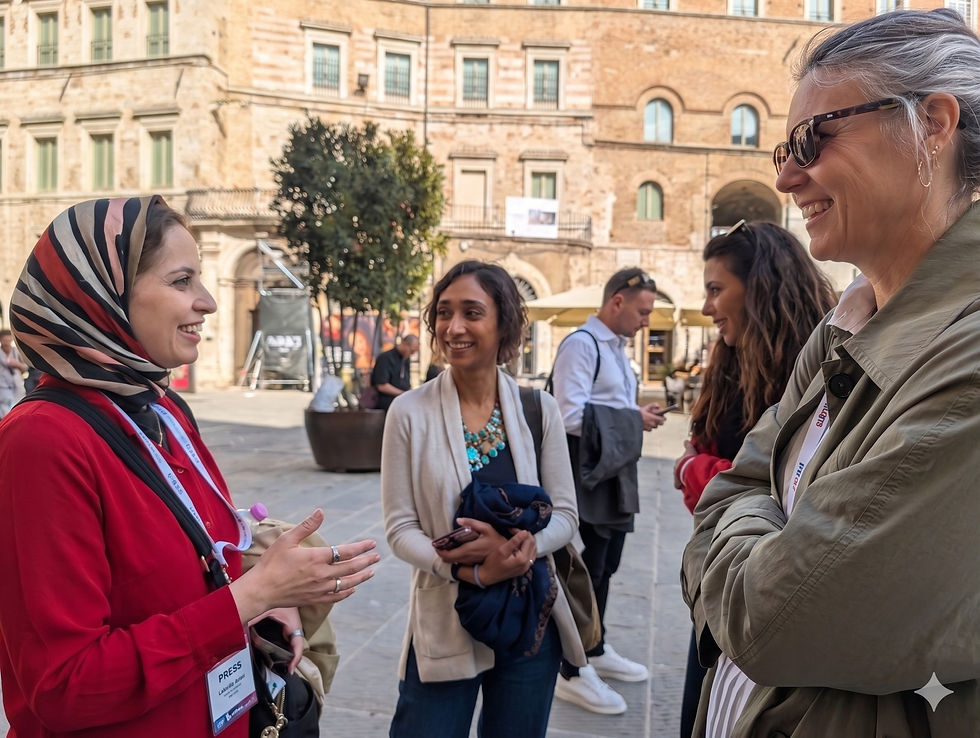
Among those I met with were foreign correspondents — writers and documentarians — who had worked in every modern war or skirmish, including Bosnia, Rwanda, the apartheid struggles in South Africa, the Troubles in Ireland, Ukraine, Gaza, and everywhere in the Middle East: Fergal Keane, Seb Walker, Singeli Agnew, Laila Al-Arian, Rhana Natour, Jen Stout, Karen Allen, Wael Al-Dahdouh, Cristian Alarcón, Eric Mugendi, Kavitha Chekuru, Oren Ziv, and many more. There were representatives of news organizations and media platforms, with an emphasis on journalists' safety, both intellectual and physical: Jodie Ginsberg of the Committee to Protect Journalists, Thibaut Bruttin of Reporters Without Borders, Raney Aronson of Frontline, Marina Walker Guevara of the Pulitzer Center, Marie Doezema of the Columbia School of Journalism in Paris, Marcus Brauchli of North Base Media, Susanne Reber with her start-up storytelling program, Galina Timchenko of Meduza, and Bruce Shapiro of the Global Center for Journalism and Trauma — among many others.
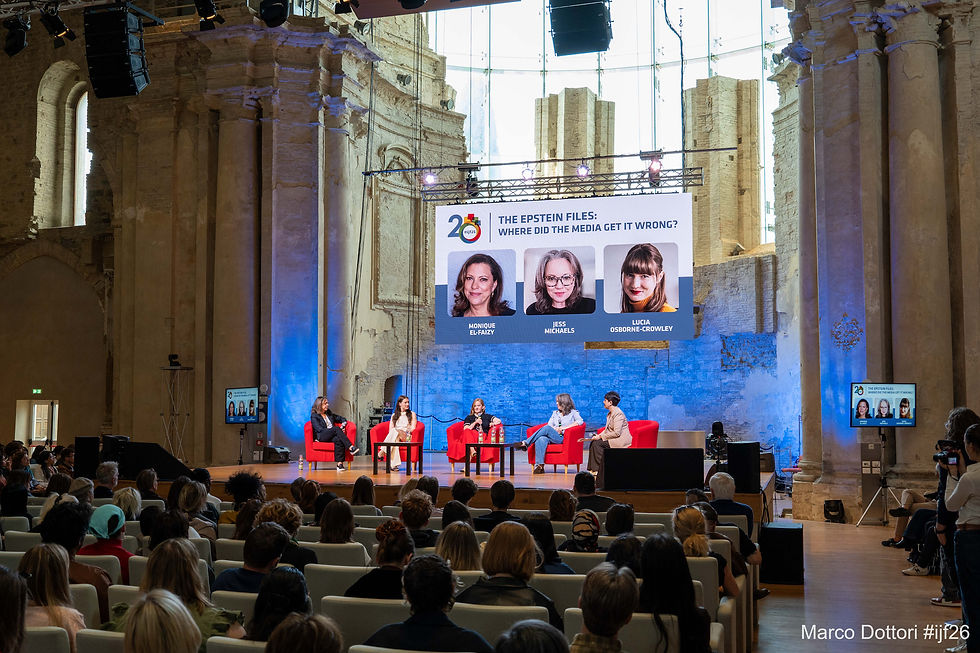
There were almost too many sessions on developing news platforms, dealing with AI, transnational collaborations, resistance journalism, and the problems of disinformation: Ukrainian journalism in the fifth year of war, Syria's media future, social justice and the media, journalists in Gaza, and censorship.
From the man from whom I rented a country house outside Perugia, to ticket takers in the Rome bus station, the car rental agent at the Perugia airport, and everyone we met — there was a sense of joy and liveliness, patience and humor. The general ambiance of Perugia, of nearby Assisi, and of Rome and the Vatican was open-armed, peace-minded, and kind wherever we went, despite the horrors of genocide, the many ongoing wars, and the ruthlessness of the rogue government in the United States. Perhaps the 800th anniversary of the death of St. Francis, being celebrated throughout Italy, had cast its compassion on us all — and hopefully will continue. The experience of the Festival, and of Italy, stays bright in my mind. Everyone I met there is already talking about returning next year.
— Gretel Ehrlich (Conan)


Comments